Why Airlines Deny Boarding When You Have No Onward Ticket
Airlines deny boarding because they pay for the mistake. Under EU Directive 2001/51/EC a carrier that flies an inadmissible passenger faces penalties of at least EUR 3,000 per person and must return them at its own cost. The agent checks IATA Timatic at the desk, and if it flags a ticket out of the country that you cannot show, you are refused.
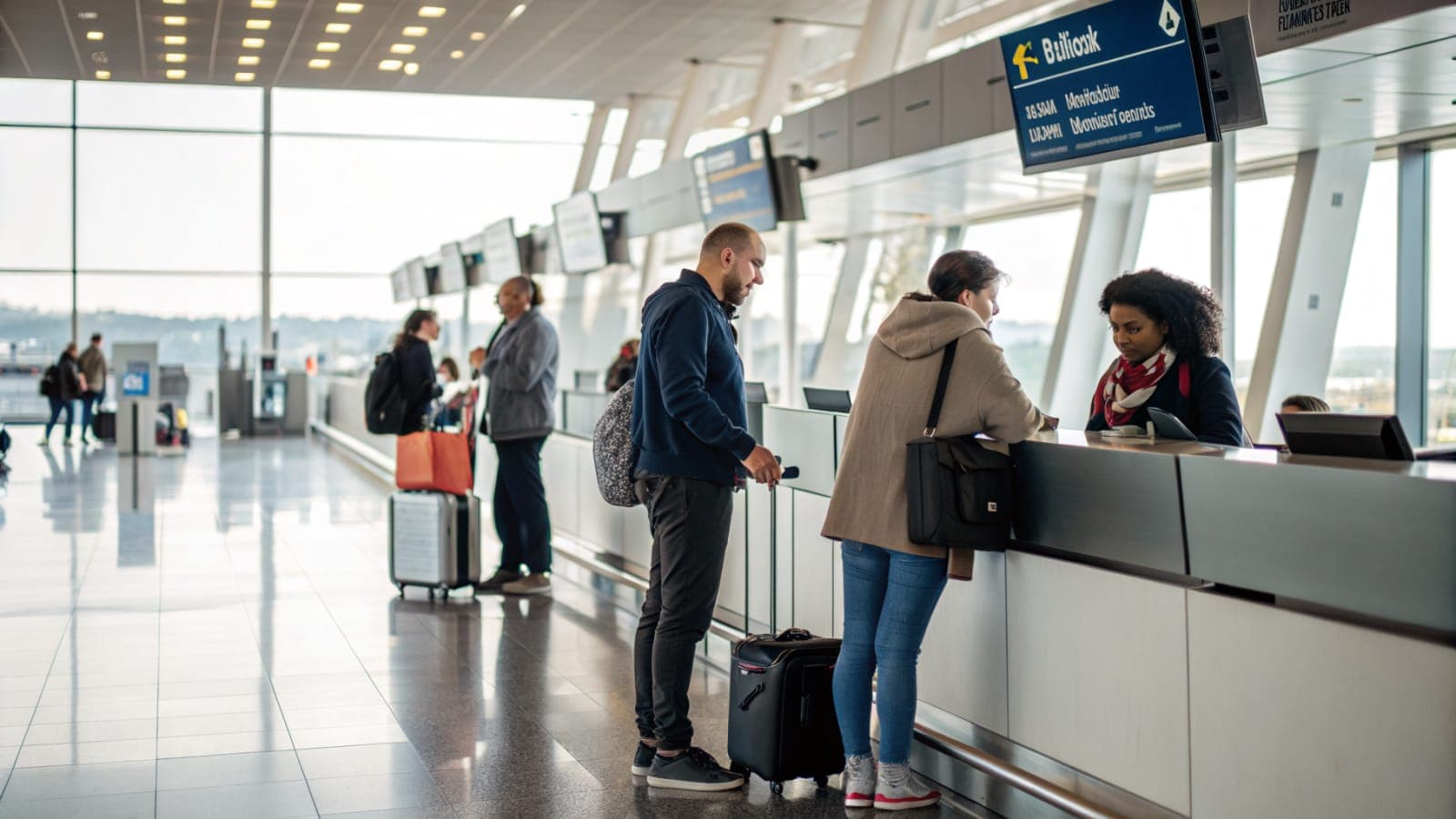
Airlines deny boarding over a missing onward ticket because the airline pays when the destination turns you away, not you. If a border officer refuses you entry, the carrier has to fly you straight back at its own expense and takes a fine on top. Blocking you at the desk in Dubai costs the airline nothing, so that is what the agent does.
What is actually happening at the desk, at a glance?
The agent is not applying their own judgement about your holiday. They are reading a screen and following a rule that carries a four figure penalty if they get it wrong.
| Fact | Detail | Source |
|---|---|---|
| What the agent checks | IATA Timatic, the industry database of passport, visa and health requirements | IATA |
| How widely it is used | Over 700 million passengers' travel documents are checked through Timatic each year | IATA |
| How current it is | Around 70 updates a day, fed by a network of over 2,000 government and airline officials | IATA |
| EU fine per inadmissible passenger | Member states must set penalties of at least EUR 3,000 per person, or a lump sum of at least EUR 500,000 per infringement | Directive 2001/51/EC |
| UK charge per passenger | GBP 2,000 for each passenger arriving without a valid immigration document, under section 40 of the Immigration and Asylum Act 1999 | GOV.UK |
| Who pays for the flight back | The carrier, which must arrange onward transport immediately and bear the cost, plus the cost of the stay if it cannot | Directive 2001/51/EC |
| What a reservation with us costs | AED 49 for 2 days, AED 69 for 7 days, AED 79 for 14 days, delivered in 10 to 15 minutes | The Dummy Ticket AE |
Why does a check-in agent care about your return flight?
Because refusing you is free and carrying you is not. Under Directive 2001/51/EC, an airline that cannot return a refused passenger has to find onward transport immediately and pay for it, and if that is not possible straight away it picks up the cost of the person's stay as well.
Then there is the fine. The same directive tells EU countries to set financial penalties of at least EUR 3,000 per person, or a maximum of at least EUR 5,000, or a lump sum of at least EUR 500,000 for each infringement, whichever route they choose.
The UK keeps it simpler. A carrier that brings in someone without a valid immigration document establishing identity and nationality, or without the required visa, can be charged GBP 2,000 for every such passenger under section 40 of the Immigration and Asylum Act 1999 (GOV.UK).
So the agent has about thirty seconds, a screen telling them what the destination requires, and a bill attached to getting it wrong. A doubtful file gets refused. That is the whole mechanism, and it explains why the country you are flying to may never get the chance to have an opinion about you.
Need proof of a booked flight?
A PNR your consulate can look up, from AED 49, with no fare to write off if the answer is no.
What is Timatic, and what does the agent see on screen?
Timatic is IATA's travel documentation database, and it is what most check-in systems query when they validate your passport against your destination. IATA describes it as the source behind over 700 million document checks a year, updated around 70 times a day from more than 2,000 government and airline officials (IATA).
The agent enters your nationality, your residence, your passport, your destination and every transit point. Timatic returns the documentation the destination requires for that exact combination. It is not a suggestion. For the airline it is the compliance record that shows the check was done.
Two things follow from that. The first is that nationality drives the answer more than anything else. A UAE resident on an Indian or Pakistani passport and a colleague on an EU passport can book the same flight and get different requirements on the same screen.
The second is that the rule often lives at the airline, not at the border. Timatic reflects what a destination tells IATA it expects, and plenty of destinations tell it that visitors must hold a ticket out. Once that line is on the screen, the agent needs to see one, and proof of onward travel is what closes it.
Airlines are also pushing the check earlier. IATA sells an automated version that runs the same rules through an API before you reach the airport, which is why some people now get an email or an app message asking for a return booking days ahead of the flight.
What do you need to show at the desk?
- A passport with the validity margin your destination requires, counted from your arrival date.
- A visa, e-visa or travel authorisation for the destination and for every country you transit.
- A ticket or reservation leaving the country, dated inside the stay you are allowed.
- A live booking reference, verifiable in Amadeus, Sabre or Travelport, not a screenshot or a PDF someone made in a design tool.
- The passenger name spelled exactly as it appears in your passport, including the order of given names and surname.
- Evidence of funds for the stay and for getting home, which the Schengen rules treat as part of the entry test (Schengen Borders Code).
- Accommodation details, and travel insurance where the destination requires it.
Does a flight reservation work, or do they want a paid ticket?
It depends on what the rule asks for, and it is worth being blunt about the difference. A reservation is a genuine booking that holds a seat under a live PNR without the fare being paid. It answers a requirement to show a travel plan. It does not answer a requirement to hold a paid, non-transferable ticket.
The clearest example is the US Visa Waiver Program. Travel.State.Gov defines the onward ticket there as a non-transferable ticket valid for not less than a year that takes the traveller out of the United States (US Department of State). That is a purchased ticket, and a hold is not a substitute for it.
Where the requirement is evidence of travel arrangements rather than a paid fare, a reservation does the job. Consular files work this way, and so do a lot of desk checks, because what the agent needs is a verifiable booking with your name, a route out and a date inside your permitted stay.
Where a specific airline insists on a paid ticket at the gate, no reservation will change that. Nothing you buy from us can override an airline's own boarding policy, and we would rather say that plainly than sell you something that fails at the counter. If you are unsure, ask the airline what it accepts before you travel, then buy a verified onward reservation if a booking is enough.
Why does this still go wrong for people who did everything right?
Most denied boarding cases we hear about are not exotic. They are a handful of avoidable mistakes, and they repeat.
The reservation expired before the flight. A hold has a life. If you bought a two day validity for an appointment three weeks ago, the PNR is dead by the time you reach the airport. Match the validity to the day someone will actually look at it.
The name does not match the passport. Agents compare character by character. A missing middle name, a swapped given name and surname, or a nickname on the booking is enough to stall the check.
The booking is not real. Anything generated as an image fails the moment someone pulls the reference. A genuine booking sits in the GDS and can be looked up there. Note that many airline websites never display an unpaid hold under Manage Booking, so the GDS lookup is the reliable check, not the airline's own site.
The transit country was ignored. Timatic checks every point on the journey. A transit visa requirement in the middle of your itinerary stops you at the first desk, even when your destination is fine.
The date sits outside the permitted stay. If you are allowed 30 days visa free and your exit is booked for day 45, the exit booking argues against you rather than for you.
The requirement was the airline's, not the country's. Some carriers apply a stricter internal policy than the destination does. You cannot argue that at the desk. You can only meet it or not fly.
None of this is about honesty. A reservation is a real booking, not a forged document, and that distinction is the whole point. The failures above are about timing, spelling and verifiability.
What does sorting it out cost?
| Option | Cost | What you get |
|---|---|---|
| Reservation, 2 days valid | AED 49 per traveller | Live PNR, enough for a same week appointment or check-in |
| Reservation, 7 days valid | AED 69 per traveller | Cover for a file that sits with a visa centre for a few days |
| Reservation, 14 days valid | AED 79 per traveller | Cover for slower processing or a shifting travel date |
| Buying a throwaway fare | The full price of the cheapest one way out, paid up front | A paid ticket you never intend to fly, with your money locked up and any refund subject to the airline's own fare rules |
| Being denied boarding | The fare you already paid, plus rebooking | Nothing. The airline keeps its exposure at zero and you go home |
The price tiers buy validity, not distance. One way and return cost the same, because what you are paying for is how long the booking stays live. If your appointment moves, we reissue with new dates at no charge, and the validity and verification questions are answered in more detail on our FAQ page.
If your trip needs a booking out of the country and a paid fare is not the requirement, an onward ticket under a live PNR is the cheap way to satisfy the check. It lands in your inbox in 10 to 15 minutes, day or night.
Sources
- IATA, Timatic Solutions (what airlines check at the desk, volume and update frequency)
- EUR-Lex, Financial penalties on passenger carriers, Directive 2001/51/EC (penalty levels and the carrier's obligation to return a refused passenger)
- GOV.UK, Charging procedures: a guide for carriers (the GBP 2,000 charge under section 40 of the Immigration and Asylum Act 1999)
- EUR-Lex, Schengen Borders Code (entry conditions, including means for the stay and the return journey)
- US Department of State, Visa Waiver Program (the non-transferable onward ticket requirement for visa free travel to the United States)
Flying without a booking out of the country?
We hold a real seat under a live PNR, so the check-in agent and the border officer can both look it up in Amadeus, Sabre or Travelport. Book an onward ticket from AED 49 and it reaches your inbox in 10 to 15 minutes, any hour of the day.
Frequently Asked Questions
Written by
Ammar Afridi
Marketing Executive
Ammar Afridi has spent four years preparing travel and visa documentation for UAE residents, working on Schengen, UK, US and Canada files and handling more than 2,000 applications.
Onward ticket
From AED 49
A genuine held seat under a live PNR, emailed to you in 10 to 15 minutes.
Get your ticketTravel insurance
From AED 30
Genuine AXA cover that clears the Schengen medical minimum, issued the same day.
Get insured